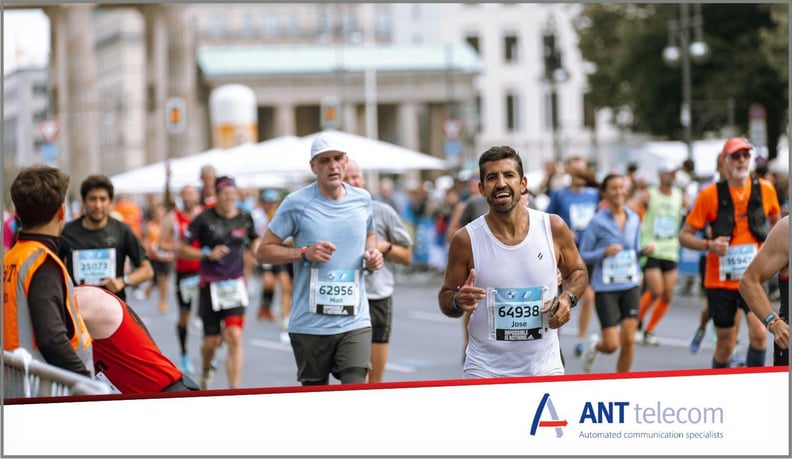
The Challenge of Keeping Teams Connected at Large-Scale Events
Whether it’s an endurance race across mountainous terrain or a multi-stage music festival, large events bring a common challenge: keeping teams connected when it matters most.
Event organisers are responsible for coordinating safety teams, medical responders, operations staff and volunteers across wide, often unpredictable environments. Communication must be instant, reliable and simple to use. When an incident happens, delays or confusion are not an option.
Traditionally, two-way radios have been the default solution. They offer immediate group communication and are familiar to most teams. But for many event organisers, especially those running multiple events across different locations, the reality is more complicated.
The Problem with Traditional Radio Systems
For large outdoor events, particularly those spread over wide areas, radios often rely on temporary infrastructure to function effectively. Repeaters need to be installed at high points, coverage needs to be engineered, and equipment must be transported, powered and secured.
This creates a number of challenges.
There is the cost. Hiring radio systems and deploying infrastructure for a single event can be expensive, especially when it has to be repeated multiple times a year.
There is the complexity. Installing and managing equipment across difficult terrain takes time, planning and specialist expertise. In remote or elevated locations, simply getting equipment into position can become a logistical exercise in itself.
And then there is flexibility. Each event is different. Routes change, layouts evolve, and scaling communication up or down isn’t always straightforward with fixed radio systems.
For event organisers looking to streamline operations and reduce overhead, this model can quickly become restrictive.
When Communication Becomes a Risk
When communication systems are difficult to deploy or unreliable in certain areas, the impact goes beyond inconvenience.
Teams may struggle to relay incidents quickly. Coordination between safety and medical personnel can slow down. Gaps in coverage can leave sections of an event effectively disconnected.
For events where organisers are responsible for participant safety, this introduces real risk. In some cases, response times are critical, and the ability to communicate instantly across the entire event footprint is essential.
At the same time, organisers are under pressure to deliver more events, in more locations, without significantly increasing operational costs.
This creates a clear tension. The need for robust mobile communication is increasing, but traditional approaches are not always keeping up.
Push-to-Talk Over Cellular (PoC)
Push-to-Talk over Cellular (PoC) offers a different approach.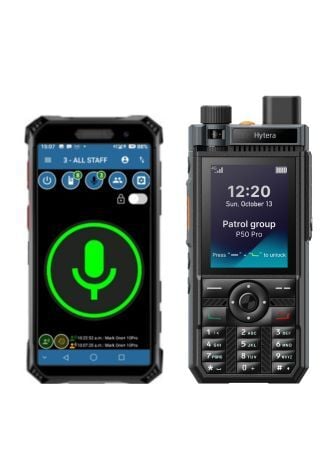
Instead of relying on local radio infrastructure, PoC devices use mobile networks to deliver instant voice communication. They look and feel like traditional radios, with a simple push-to-talk button and group calling, but operate via a cloud-based platform.
For event organisers, this removes one of the biggest barriers: the need to deploy and manage physical infrastructure.
Communication groups can be configured in advance, whether that’s safety teams, medical staff, logistics or an all-call channel. Devices can be distributed across multiple locations, even across different countries, and still operate within the same system.
Because the solution is managed centrally, any changes can be made remotely without needing to reprogram devices on-site.
Why PoC Works for Large Events
For event organisers already familiar with radios, the transition to PoC is straightforward. The user experience remains simple, but the underlying capability becomes far more flexible.
In practice, this means teams can communicate across wide areas without worrying about where repeaters are placed. As long as there is some mobile coverage, communication can continue.
It also means equipment can be reused across multiple events without the need to rebuild a network each time. Whether an event is in the UK one weekend and mainland Europe the next, the same devices and setup can be used.
For organisers running simultaneous events in different locations, groups can be separated and managed independently, all within a single system.
And importantly, the cost model becomes more predictable. Instead of repeated infrastructure deployment, organisers invest in a solution that can be used continuously.
Built for Reliable Communication in Challenging Environments
One of the concerns event organisers often have with 4G and 5G communication is reliability. If thousands of people are attending an event and using their phones at the same time, the network can get congested.
It's a valid concern. But not all Push-to-Talk over Cellular solutions are configured in the same way.
We design our solution using multi-network roaming SIMs within our PoC devices to improve resilience and coverage. Instead of relying on a single mobile network, the devices can switch between available networks where coverage is weak or unavailable. For large outdoor events, remote locations or challenging terrain, this gives teams a much better chance of maintaining communication across the entire event area.
There is another important difference during busy events.
The SIMs we use operate differently from standard consumer mobile SIM cards. At large events, where thousands of attendees may be uploading content, streaming video or using social media simultaneously, mobile networks can become congested.
In these situations, standard mobile devices can struggle to maintain reliable connectivity. Our PoC solution is designed to perform far more reliably in these high-demand environments, helping event teams stay connected even when public network usage is extremely high.
For organisers, this adds an important layer of confidence. Communication teams are not relying on the same type of connectivity as the general public.
Combined with advance route testing, coverage checks and ongoing support from our team, this helps ensure the PoC solution performs reliably before the event even begins.
Real-World Validation: Testing Before Deployment
One of the key considerations with PoC is coverage. While modern mobile networks provide extensive reach, understanding performance across a specific event area is essential.
In real-world deployments, this is addressed through testing.
Devices can be trialled in advance, often using headsets to mirror actual event conditions, allowing organisers to assess coverage across routes, checkpoints and critical locations. This ensures confidence that the solution will perform when it is needed most.
With the right preparation, PoC can become the primary communication method, with traditional radios used only as a fallback in the rare areas where coverage is unavailable.
A Simpler Way to Deliver Reliable Event Communication
For large-scale event organisers, communication should enable operations, not complicate them.
Push-to-Talk over Cellular offers a practical alternative to traditional radio systems, reducing the need for infrastructure, simplifying deployment and providing the flexibility to operate across multiple locations.
With the right support, from initial setup and testing through to ongoing assistance, organisers can adopt PoC with confidence, knowing their teams will stay connected when it matters most.
Want to explore Push-to-Talk for your event teams?
If you’re planning large events and looking for a more flexible, cost-effective way to keep your teams connected, it may be time to rethink your approach to communication.
Speak to us about how Push-to-Talk over Cellular can support your events, wherever they take place.