Manual freezer checks create overnight blind spots
Many organisations still rely on manual freezer temperature checks carried out once or twice a day. A member of staff checks the display or an internal thermometer, records the reading, and moves on.
On the surface, this feels controlled. There is a process, a record, and a sense of compliance.
The reality is that freezers don’t fail when people are watching them. They fail overnight, when buildings are unmanned and no checks are taking place at all. When staff arrive the next morning and discover an issue, it is already too late to know what really happened.
Nobody can tell exactly when the temperature started to rise, how long it was out of range, or whether the contents were ever truly at risk. Faced with that uncertainty, the safest option is often to assume the worst.
Realising manual monitoring isn’t enough
As estates grow and the number of freezers increases, the limitations of manual checks become obvious. Walking between units, logging readings, and hoping nothing goes wrong between checks is not a scalable or resilient approach.
At this point, many organisations recognise the risk and take the next logical step. They introduce a freezer monitoring system that records temperature automatically and raises alarms when thresholds are breached.
This feels like a significant improvement — and in many ways, it is.
But for some teams, a new problem quickly emerges.
Data exists, but it’s locked away
In some monitoring setups, freezer temperature data is captured continuously, but it is stored on a specific PC or local system on site. When a threshold is breached, an alarm is raised, and someone is notified.
During working hours, this is manageable. Staff can access the system, view the data, and decide what action to take.
Out of hours, it becomes a serious issue.
When an alarm triggers overnight, the person being contacted cannot see the data unless they are physically on site or have access to that specific computer. They cannot check whether the temperature is still rising, whether it peaked briefly and is already dropping, or whether the freezer has stabilised.
Despite having a monitoring system in place, they are effectively blind.
Why this leads to unnecessary callouts and frustration
Without remote access to data, every alarm has to be treated as a potential emergency. Staff are woken during the night and asked to travel in simply to find out what is happening.
In many cases, the issue turns out to be short-lived. A brief power fluctuation, a normal freezer oscillation pattern, or a transient event may have caused the temperature to rise just long enough to breach the threshold. By the time staff arrive on site, the freezer may already be back within range.
Because there was no way to check this remotely, the callout still happened.
Over time, this creates real frustration. Staff morale suffers, confidence in the system drops, and out-of-hours callout costs add up. A system that was introduced to reduce risk starts to feel like another operational burden.
Monitoring without accessibility limits decision-making
The challenge here is not that data is missing. It is that the data is not accessible when it is needed most.
When temperature data can only be viewed from a single on-site location, it cannot support informed decision-making out of hours. Staff are forced to act without evidence, relying on caution rather than clarity.
This increases disruption and can also increase risk. When people are repeatedly called out for issues that resolve themselves, there is a danger that genuinely serious alarms begin to blend in with less critical events.
Freezer monitoring with secure remote access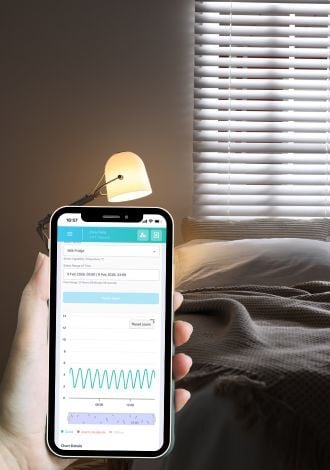
An effective freezer temperature monitoring system combines continuous data collection with secure remote access. When an alarm occurs, staff should be able to view live and recent temperature data from wherever they are.
That visibility allows them to see whether the temperature is continuing to rise or whether it is already recovering. They can understand how long the freezer was out of range and whether similar events have occurred before.
In many cases, this removes the need for an unnecessary site visit. Staff can continue to monitor the situation remotely and only attend site if the data shows that the problem is ongoing or escalating.
Remote access does not replace alarms. It makes them meaningful.
Freezer monitoring should remove uncertainty, not add to it
Organisations invest in freezer monitoring to gain peace of mind. If a system still forces staff to travel in just to see what’s going on, it has not fully solved the problem.
The real goal is simple: know what is happening, know it in time, and know whether action is genuinely required.
Freezer monitoring that makes data accessible as well as accurate achieves exactly that.
Want to explore this further?
If temperature monitoring is something you’re responsible for — or something you get pulled into when issues arise — it’s worth stepping back and asking whether your current setup really supports out-of-hours decision-making.
If you’d like to talk through common freezer monitoring challenges or explore how remote access can reduce unnecessary callouts, we’re always happy to share what we’ve seen work well in practice.