
Clear, reliable communication is fundamental to workplace safety and productivity. In many environments, communication is not just important — it is critical. Whether coordinating emergency response, managing first aid incidents or responding to fire alarms, organisations rely on communication systems that must work every time.
However, in large or complex buildings, poor 2G, 4G and 5G mobile reception often makes this difficult. Modern building materials, insulated walls and compartmentalised layouts can significantly weaken mobile signals, leading to calls that fail to connect, drop unexpectedly or suffer from poor voice quality.
When people cannot hear each other clearly — or avoid calling altogether because it’s unreliable — productivity suffers and risk increases. In safety-critical environments, these limitations make mobile-dependent communication a serious concern.
When Critical Voice Communication Becomes Unreliable
One of the most common challenges organisations experience is the inability for people to reliably reach each other by mobile phone inside their buildings. Calls may not connect at all, may drop as users move between areas, or may connect but with poor audio quality.
Voice quality is often the hidden problem. Even when calls technically go through, poor mobile reception can cause clipped speech, delays and distortion, making it difficult for callers to understand each other clearly. Conversations take longer, instructions have to be repeated, and frustration builds.
Over time, users lose confidence in voice communication and begin to avoid calling unless absolutely necessary.
How Critical Communication Failures Affect Safety and Efficiency
When voice communication becomes unreliable, behaviour changes. Instead of calling a colleague, staff walk across buildings to find them in person. Simple questions turn into lengthy interruptions, and unplanned face-to-face conversations become a workaround for unreliable calls.
This has a direct impact on productivity. Time is lost, workflows are disrupted and teams spend more effort communicating than they should. Over the course of a shift or a week, these small inefficiencies add up.
In safety-critical situations, the impact is more severe. During first aid incidents, fire alarms or emergencies, poor voice quality or delayed communication can slow response times, increase confusion and add uncertainty at exactly the wrong moment. At that point, communication is no longer just inefficient — it becomes a risk.
IP DECT as a Platform for Critical Voice Communication
IP DECT communication systems are designed specifically for reliable, in-building voice and messaging, independent of public mobile networks. Because it operates on its own dedicated infrastructure, it is not affected by fluctuations in 2G, 4G or 5G coverage inside buildings.
This provides predictable voice quality and fast call setup wherever users are working on site. Calls remain clear and stable, even as people move around the building, removing the uncertainty and frustration associated with poor mobile reception.
DECT also offers fast and reliable message delivery. Unlike text messages, which can be delayed or fail to deliver entirely when mobile signal is weak, messages are delivered immediately across the local system. For critical alerts and notifications, this reliability is essential.
Importantly, users can make and receive external calls. Staff can contact suppliers, emergency services or colleagues off site, and receive return calls directly to their handset, without relying on mobile coverage inside the building.
Because DECT operates on a standalone network, it is often preferred from a cyber security perspective and is unaffected by public mobile network outages. Issues such as a Vodafone or other carrier outage do not impact in-building communication, helping organisations maintain continuity when external networks are unavailable.
Protecting Lone Workers with Immediate, Acknowledged Alerts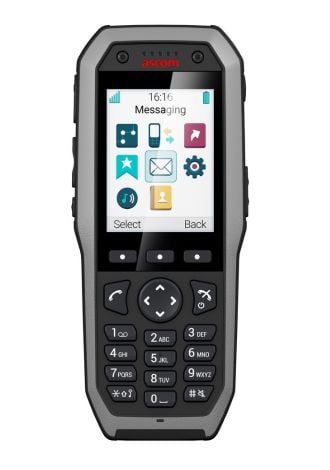
In many safety-critical environments, staff may work alone or in isolated areas. In these situations,
the ability to raise an alarm quickly and confidently is essential.
DECT handsets can be equipped with integrated SOS buttons and man-down alarms, allowing users to trigger an alert instantly if they feel unsafe, become unwell or suffer a fall. Alarms are sent directly to predefined response teams and must be acknowledged, providing reassurance that help is on the way.
This acknowledgement-based approach removes ambiguity and ensures incidents are actively managed rather than passively broadcast.
Improving Fire Response Across Complex and Multi-Building Sites
Fire response presents another common critical communication challenge, particularly on sites with multiple buildings or large, compartmentalised layouts. Fire marshals in one area may not hear alarms triggered elsewhere, delaying investigation and response.
By integrating an IP DECT system with the fire alarm system, fire marshals are notified directly on their handsets as soon as an alarm is activated. Notifications include information about the location of the alarm, allowing teams to respond quickly and appropriately.
If a single smoke detector is triggered, marshals can investigate promptly, helping to identify false alarms and prevent unnecessary disruption. In confirmed fire situations, DECT enables marshals and fire teams to coordinate evacuation effectively, direct employees to safe exits away from the fire, and maintain clear communication throughout the incident. Teams can also contact emergency services quickly and reliably when required.
Coordinating First Aid Response with Confidence
First aid incidents demand both speed and clarity. Without a reliable communication system, alerts can be missed or responded to inconsistently, leading to confusion or delays.
With DECT, first aid teams receive notifications directly on their handsets when assistance is required. Messages must be acknowledged, ensuring that one responder attends the incident rather than multiple people responding unnecessarily or, worse, no one responding at all.
This controlled, closed-loop communication improves response times and gives organisations confidence that incidents are being handled efficiently and appropriately.
Why IP DECT Continues to Matter for Critical Communication
In safety-critical environments, communication systems are not judged by the number of features they offer, but by whether they perform consistently under pressure. Reliable voice quality, predictable coverage and assured delivery of critical alerts all contribute to safer operations and faster response when it matters most.
By combining dependable in-building voice communication with acknowledged alarms and clear escalation paths, DECT provides a robust platform for critical communication — helping organisations reduce risk, improve efficiency and restore confidence in how their teams communicate.
Talk to Us About your Communication Challenges
If voice reliability inside your buildings is affecting safety, response times or productivity, we can help. Our mobile solutions are designed to support critical communication in environments where reliability cannot be left to chance.
Get in touch to discuss your challenges and explore how DECT could support safer, more effective communication across your site.