An IP DECT phone system gives your teams reliable wireless voice across a whole site, on a dedicated network that does not depend on the public mobile signal or your Wi-Fi. Coverage is designed around your buildings through a site survey, so handsets work in the plant rooms, basements and steel-framed areas where mobiles drop out. ANT Telecom supplies, installs and maintains IP DECT systems for organisations that rely on dependable on-site communication.
It is one of the three technologies in our industrial communication systems range, alongside two-way radio and push to talk over cellular. This page explains what an IP DECT system is, how it works, the handsets we supply and how it connects to your alarms. If you would rather talk it through against your own site, book a site assessment and one of our consultants will walk it with you.

An IP DECT phone system is a private wireless voice network built from base stations and cordless DECT handsets, connected over your IP network. DECT runs on its own dedicated frequency band, so it does not compete with Wi-Fi or public mobile networks for capacity. That is what gives it consistent call quality and reliable delivery of messages and alarms, even when the site is busy.
Unlike consumer cordless phones, a professional IP DECT system is engineered for scale and for harsh environments. It covers large buildings and multi-building sites, hands calls between base stations as people move, and integrates with the alarm and safety systems already on site. For most operators the driver is business critical communication: making sure a call for help, a machine fault or a fire alert reaches the right person first time.
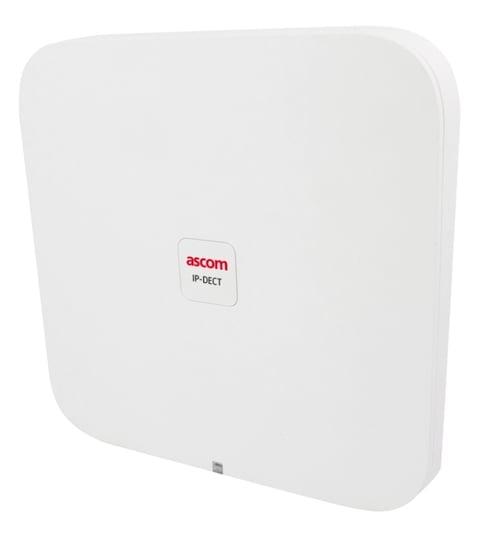
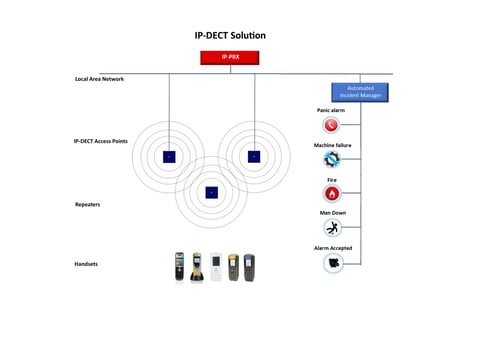
Coverage comes from IP DECT base stations, also called access points. Each one connects to your network and works with the others to form a multi-cell system. As a user moves around the site, the call is handed over from one base station to the next without interruption, so a conversation started at the gatehouse can continue on the factory floor. The number and placement of base stations is worked out through a site survey, which is why the system holds up in the areas where mobile coverage fails.
A management layer sits on top, handling call routing, messaging and the rules for how alarms reach handsets. Multiple base stations let one IP DECT system cover large warehouses and manufacturing plants, hospitals and healthcare sites, hotels and secure campuses under a single network.

We supply a wide range of professional DECT handsets from leading manufacturers, including Ascom, Funktel and Wildix, matched to the job and the environment rather than to a single stack. Options include:
Every handset can make and receive internal and external calls, send and receive messages, and trigger or receive alarms anywhere within the IP DECT network. Where staff work alone, the same device carries lone worker protection, so there is no second gadget to issue or charge.

One of the main advantages of IP DECT is that it does not sit on its own. As a system integrator, we bring your existing systems together so alerts land directly on the handsets your teams already carry. Our critical alarm management platform routes each alert to the right responder, escalates if nobody acknowledges it and logs the whole event for audit.
Typical integrations include fire alarm panels, nurse call systems, building management systems, machine and process alarms, gas detection and door or gate entry. Engineers and ward staff no longer need to stay within sight of a control screen: the alarm finds them, wherever they are on site. For maintenance and operations teams that means faster response, less downtime and a clear record that critical alerts were received and actioned.
IP DECT suits any site where reliable voice and alarms matter and mobile coverage cannot be trusted. The environments we work in most often are:
Large buildings, noisy floors and patchy indoor coverage make manufacturing plants the classic IP DECT environment. Machine and process alarms delivered to handsets keep engineering teams mobile instead of tied to a control room. See how the technology works on a distillery site in our Tamdhu case study.
Cleanrooms, process areas and hazardous zones need dependable voice and fast alarm response, often on ATEX-certified handsets. IP DECT delivers both on a network that is independent of the public mobile signal, with lone worker alarms and process alarms routed straight to the handset. Learn how we helped a leading pharmaceutical manufacturer improve communication and safety.
Housekeeping, maintenance and front-of-house teams move constantly across floors and back-of-house areas where mobile signal is weak. IP DECT keeps them reachable and lets reception, fire and building systems reach them instantly. More on our work in hotels.
Distribution centres, large stores and mixed commercial sites use IP DECT for site-wide voice, stock and security coordination, and alarm alerts to roaming staff, all on one network that scales as the site grows.
In hospitals, communication is clinical infrastructure: DECT handsets integrated with nurse call and fire systems keep ward staff reachable, with alarm escalation and a full audit trail. Secure sites use the same reliability for staff safety, as at Rossie, a secure children's home.
Mobile phones depend on a signal you do not control, and public coverage is routinely blocked by steel, concrete and depth below ground. Wi-Fi was built to carry data, not safety-critical voice, and consumer handsets are not rugged, not certified for hazardous areas and have no instant messaging or alarm integration. IP DECT runs on its own dedicated infrastructure, so it keeps working when the mobile network does not, with better call quality and reliable alarm delivery. Where teams also work across multiple sites or out in the field, we combine it with push to talk over cellular or two-way radio.
A consultant walks your site with you, looking at how it operates in reality: where coverage fails, where people work alone, which alarms and systems need to reach mobile devices, and how the buildings behave. You get a recommended IP DECT design with options, sized for both current operations and future change, with no obligation attached.
From there we handle deployment end to end: professional installation, integration with your existing telephony and alarm systems, coverage testing and role-appropriate training. Support continues after go-live from people who know your site and your system, and as your operation changes we help the solution change with it.
We are an independent integrator, not a box shifter. We have spent more than 30 years designing communication solutions around how sites actually operate, specifying across manufacturers rather than pushing a single stack. We hold ISO 9001 certification for quality management and are SafeContractor and Achilles accredited. Organisations including Eurotunnel, Severn Trent Water , O-I and Tamdhu Distillery trust us with their site communication, and most of our customer relationships run for many years because the support does not stop at go-live.
IP DECT is designed for indoor and on-site communication. It runs on dedicated infrastructure, so it gives reliable coverage in buildings where mobile signal is poor, with better call quality and instant messaging and alarms that mobiles cannot match.
Yes. An IP DECT system runs entirely on its own base stations and network, so it works in basements, plant rooms and remote buildings with no mobile coverage at all.
Yes. Adding base stations extends coverage across large or multi-building sites as a single multi-cell system, with calls handed over seamlessly as people move between areas.
Yes. Fire panels, nurse call, building management, machine alarms and gas detection can all deliver alerts directly to DECT handsets, with automatic escalation if the first responder does not acknowledge.
DECT gives reliable, high-quality voice within a defined site. Two-way radio is best for instant push-to-talk across large or remote areas. PoC uses mobile networks or Wi-Fi for UK-wide or worldwide reach without dedicated infrastructure. The right choice depends on coverage, environment and how your teams work.
Tell us how your site operates and where communication lets you down, and we will design an IP DECT system around it. Book a site assessment or call us to talk it through first.