Two way radio gives teams a fast and reliable way to communicate across large and challenging sites. With one press of a button, users can speak immediately to an individual or an entire group, making it easier to coordinate tasks, communicate as a team and respond quickly during an emergency.
Unlike a mobile phone call, there is no need to dial a number and wait for somebody to answer, and a dedicated radio system does not depend on public mobile coverage. ANT Telecom designs, supplies, installs and maintains two way radio systems around the environment and the way teams need to communicate.
Two way radio is one of the three technologies within our industrial communication systems range, alongside IP DECT and Push-to-Talk over Cellular (PoC). This page explains how professional radio systems work, the different radios available, and how coverage, capacity, worker safety and alarm integration can all form part of the solution. If you’d like to know how it could support your site, book a site assessment and one of our consultants will walk you through it.
A two way radio system is a private wireless communication system that allows people to communicate instantly using push-to-talk (PTT). When a user presses the PTT button and speaks, their message is broadcast immediately to an individual or predefined group. Colleagues hear the message on their radios and can respond in the same way, allowing teams to have quick, two-way conversations and coordinate activities as they happen.
Radios use dedicated radio frequencies and do not depend on public mobile networks or Wi-Fi. Depending on the application, VHF or UHF frequencies can be used, with UHF commonly used in buildings and industrial environments.
On smaller sites, radios may communicate directly with each other. Larger or more challenging environments may require repeaters to extend coverage.
Users can also be organised into different talk groups, allowing departments or operational teams to communicate separately without everybody having to listen to every conversation.
Most professional radio systems we install today use Digital Mobile Radio (DMR) technology.
Compared with traditional analogue radio, DMR can provide clearer audio, more efficient use of available radio channels and additional functionality such as messaging, GPS location and worker safety features.
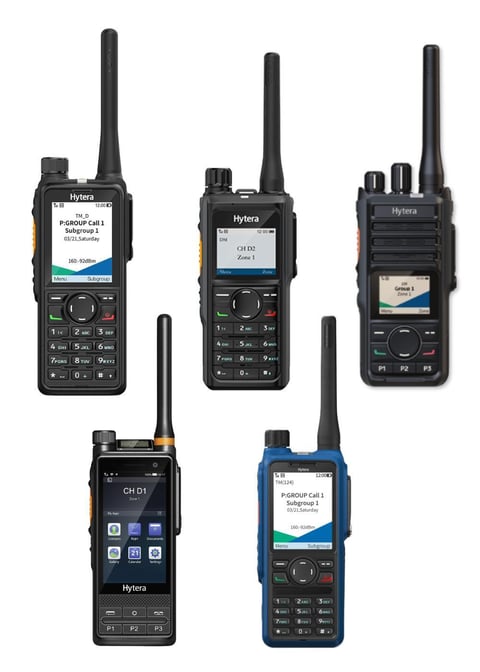
We supply professional two way radios from established manufacturers including Hytera, Motorola and Entel, giving us the flexibility to recommend equipment around your operational requirements rather than limiting the solution to a single manufacturer.
The right radio will depend on where it will be used, the features required and your existing equipment or preferences. Options include rugged handheld radios for everyday industrial use, ATEX-certified devices for hazardous areas, and mobile radios for vehicles and fixed locations.
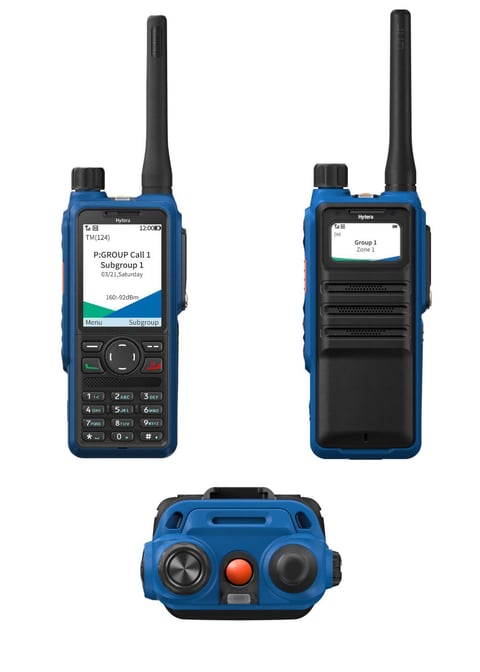
Where employees work in potentially explosive environments, standard electronic equipment may not be suitable.
ATEX radios are designed for hazardous locations where gases, vapours, mists or combustible dust could potentially be ignited by electrical equipment.
Different ATEX zones identify the likelihood of an explosive atmosphere being present:
Zone 0 / 20 – an explosive atmosphere is present continuously or for long periods.
Zone 1 / 21 – an explosive atmosphere is likely to occur occasionally during normal operation.
Zone 2 / 22 – an explosive atmosphere is unlikely to occur during normal operation and, if it does, will normally only exist for a short period.
The radio selected therefore needs to be certified for the environment in which it will be used. Intrinsically safe radios are engineered to limit electrical and thermal energy so the equipment does not provide an ignition source.
This makes specialist radio equipment particularly important in chemical plants, petrochemical facilities and other hazardous industrial environments.
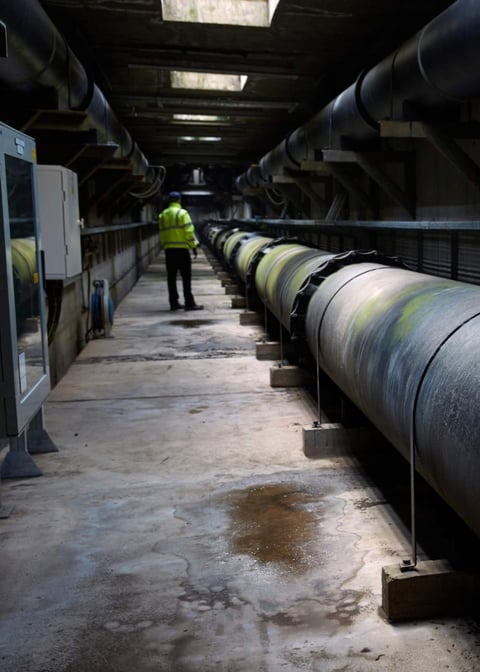
The same radio used for everyday communication can also help an employee raise an alarm when they need assistance.
Supported radios can include dedicated emergency buttons, man-down functionality that automatically raises an alarm if an employee may have fallen or become incapacitated, and GPS to help establish their location.
This can be particularly valuable for engineers, maintenance teams, security personnel and others who spend periods working alone or away from colleagues.
Severn Trent Water, for example, operates sites where employees work underground in basements, tunnels and pipe galleries, sometimes with little or no mobile coverage. ANT Telecom has implemented digital radio systems across a number of its sites, providing site-wide communication alongside lone worker protection.
Employees can call for help or use the panic button on their radio in an emergency. If someone falls or becomes incapacitated, man-down functionality can automatically raise an alert, while GPS helps colleagues locate the person requiring assistance.
The radio system also integrates with Severn Trent's SCADA alarm management system, allowing critical operational alarms to reach engineers wherever they are working on site.
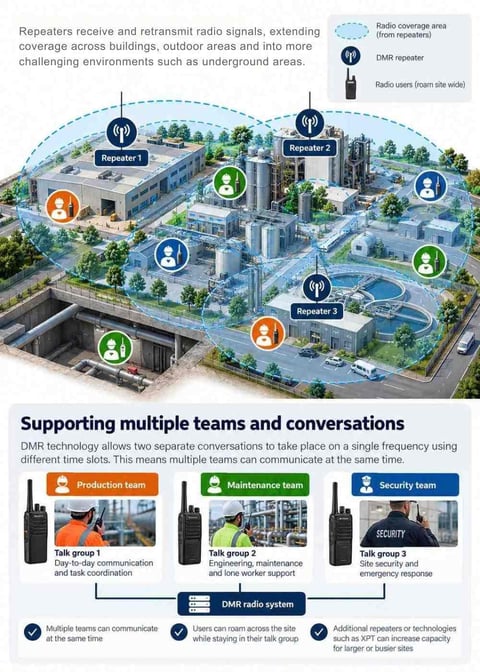
Two important considerations when designing a professional radio system are coverage and capacity.
Coverage determines where users can communicate. Steel structures, machinery, thick walls, underground areas, changes in elevation and the size of a site can all affect how far a radio signal travels.
Where direct radio-to-radio communication isn't sufficient, strategically positioned DMR repeaters can receive and retransmit radio signals to extend coverage into harder-to-reach areas.
Capacity determines how many conversations the system can support. For example, maintenance, production and security teams may need to communicate independently and at the same time.
DMR technology allows two separate conversations to take place on a single frequency using different time slots. For larger or busier sites, additional repeaters and technologies such as XPT or digital trunking can increase capacity further, making radio resources available to different talk groups as required.
We therefore design around both where people need to communicate and how many people or groups need to communicate simultaneously, while considering how requirements may change in the future.
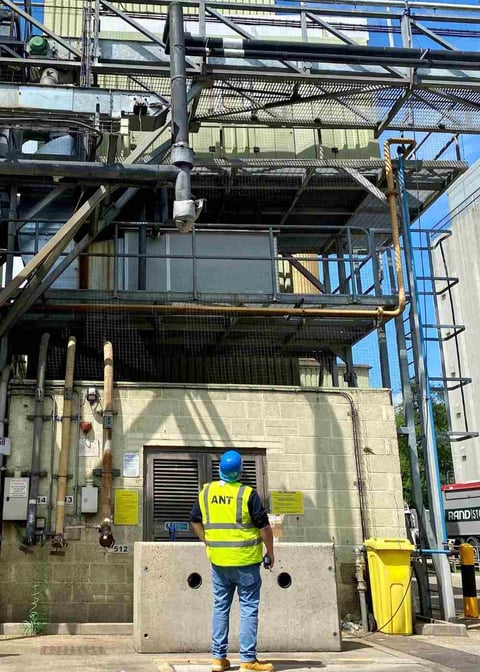
Before recommending a radio system, we need to understand the environment in which it will operate. This will normally begin with a discussion about how your teams work, where they need to communicate and any operational or safety challenges you're trying to address.
During a site assessment, we'll walk the site with you to understand the working environment in more detail. This is where we'll consider requirements such as the number of users and talk groups, system capacity, lone worker and ATEX requirements, and whether operational or safety alarms need to reach radio users.
A radio coverage survey may be carried out at the same time or at a later date. This focuses specifically on testing radio signal strength and identifying areas where coverage may be weak or unavailable. We can test across buildings, production areas, external spaces, basements and other locations where your teams need to communicate.
The findings help us determine whether radios can communicate directly or whether repeaters or other infrastructure will be required to provide the necessary coverage and capacity across the site.
We can then recommend a system design and suitable radios before programming, installation, testing and user training.
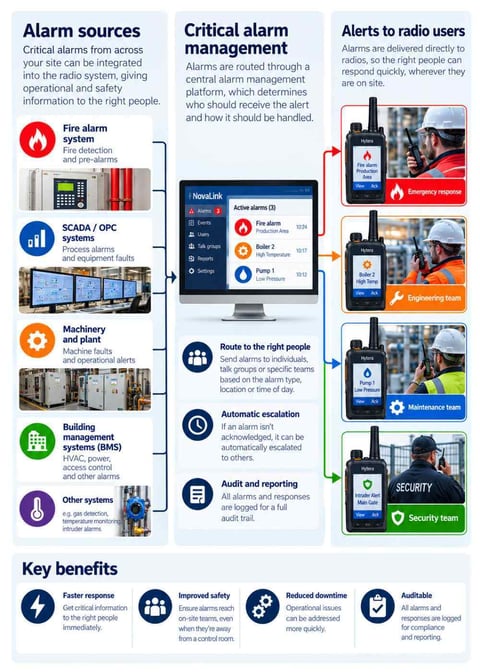
Your radio network doesn't have to operate independently from other systems across your site.
Critical alarms from machinery, SCADA/OPC systems, fire panels, building management systems and other operational equipment can be integrated and delivered directly to appropriate radio users.
For example, if a piece of machinery develops a fault, an alert can be automatically distributed to the people responsible for responding rather than relying solely on somebody monitoring a control screen.
Critical alarm management software can determine who should receive an alarm and automatically escalate it to another person or group if it isn't acknowledged, helping establish a defined and auditable response.
This means the same radio used for everyday communication can become part of a wider communication, safety and alarm management system.
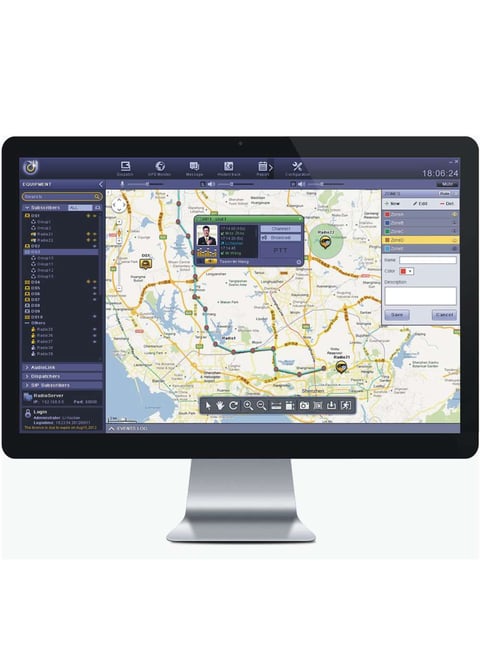
For larger systems, dispatcher software can provide a central view of radio users and communications.
Depending on the system, a dispatcher can communicate with individuals or groups, view user locations, manage emergency alerts and coordinate incident response.
Voice recording and call logging can also provide a record of communications for incident reviews, procedures or training.
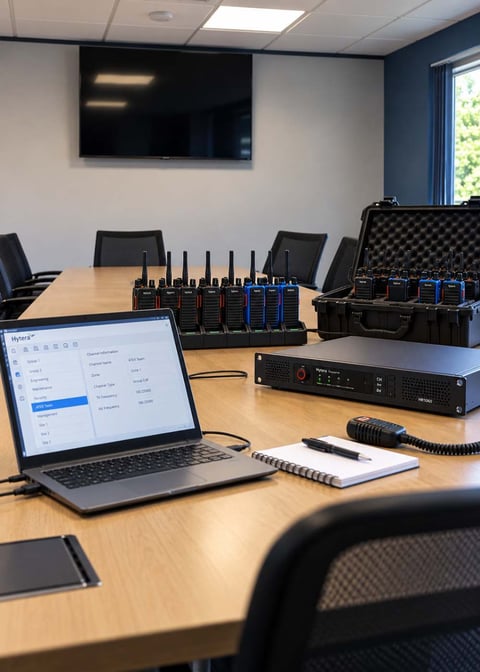
Not every organisation needs to purchase a radio system. Two way radio hire can provide a flexible option for temporary requirements, short-term projects, events or situations where additional radios are needed for a limited period.
We can provide professional two way radios configured around your requirements, including standard and ATEX radios for hazardous environments. Repeaters can also be supplied where additional coverage is needed across larger or more challenging sites.
Tell us how many radios you need, where they'll be used and what you need them to do. We can recommend suitable equipment and configure the radios around your requirements, including any repeaters needed to support coverage across the site.
Two way radio is particularly well suited to environments where communication needs to be immediate, teams are highly mobile or public mobile coverage cannot always be relied upon.
Radio allows production, engineering and maintenance teams to communicate instantly across factories and industrial sites, including environments where machinery, steel structures and large buildings can make communication more challenging. See how the technology supported Sherwin Williams in one of our latest case studies.
Water treatment works, wind farms and other utility environments can include large, underground, enclosed or remote areas. Radio can provide site-wide communication, while integrations such as SCADA/OPC can deliver operational alarms to engineers away from a control screen. Learn how you can manage alarms more easily in our Severn Trent Water case study.
Two way radio systems give site managers, contractors and operational teams an immediate way to communicate across busy construction environments. As a project develops, changing structures can affect coverage, so the radio system can be adapted and repeaters introduced where required.
Chemical and petrochemical sites can combine challenging communication requirements with areas where standard electronic equipment cannot safely be used. Intrinsically safe ATEX radios allow employees to communicate within appropriate hazardous zones, while supported devices can also provide SOS, man-down and location functionality as at Synthomer.
Two way radio can provide instant group communication for hospital teams such as security, facilities, portering and estates, helping employees coordinate routine activities and respond quickly when assistance is required.
Radio gives housekeeping, maintenance, security and operational teams a quick way to communicate across hotels and other large venues without making individual telephone calls.
Schools, colleges and universities can use radio to provide immediate communication between security, facilities, caretaking and other operational teams working across buildings, campuses and outdoor areas.
ANT Telecom has been helping organisations improve communication across challenging working environments for more than 30 years. We don't simply supply radio handsets. We can support the complete system, from understanding your requirements and carrying out site and coverage assessments through to system design, programming, installation, integration, training and ongoing maintenance.
As an independent systems integrator, we aren't tied to a single radio manufacturer. We work with established manufacturers including Hytera, Motorola and Entel, allowing us to recommend equipment based on your environment, operational requirements and budget.
Our experience also extends beyond radio. We work with IP DECT, Push-to-Talk over Cellular (PoC), lone worker safety and critical alarm management, including the integration of systems such as SCADA/OPC and fire alarms. This wider experience means we can consider how radio fits into your broader communication and safety requirements rather than treating it as a standalone system.
ANT Telecom is certified to ISO 9001 for Quality Management, ISO 27001 for Information Security Management and ISO 14001 for Environmental Management, and is also Cyber Essentials certified. For our customers, this provides added assurance that projects are managed using robust processes, information is handled securely and we're continually working to improve the quality and environmental impact of the services we provide.
Our experience includes large and complex radio deployments. For example, we work with Eurotunnel and installed a Hytera digital radio solution across its UK and French terminals, supporting its phased migration from analogue to digital radio. At the time, between 300 and 400 marshals were using the solution each day across its operations.
A two way radio is a device that can both transmit and receive radio communications. Unlike a mobile phone, users can communicate instantly using push-to-talk without dialling a number or waiting for somebody to answer.
A two way radio converts the user's voice into a radio signal and transmits it on a specific frequency. Other radios using the appropriate channel receive the transmission. Radios can communicate directly or through repeaters where additional coverage is required.
Analogue radio transmits voice directly as a radio signal, while Digital Mobile Radio (DMR) converts voice into digital information. DMR can provide clearer audio, more efficient use of available radio channels and additional functionality including messaging, GPS and worker safety features.
Most professional business radio systems require an Ofcom radio licence. Licence-free PMR446 radios can be used without one, but operate on shared frequencies available to anyone. Other radio users nearby could therefore use the same channel, causing interference or allowing conversations to be overheard.
A licensed business radio system gives organisations access to frequencies intended for licensed use, helping reduce interference and provide a more dependable communication environment. The appropriate licence depends on where and how the system will be used.
A radio licence does not, by itself, make conversations private or encrypted. Where communication security is important, additional digital radio security features can be considered.
ANT Telecom can advise on the appropriate Ofcom licence and apply for licences on your behalf.
Radio range depends on the environment. Buildings, steelwork, machinery, terrain and whether radios are used indoors or outdoors can all affect coverage.
Rather than relying on theoretical manufacturer range figures, a radio coverage survey can establish how radio performs across your site and whether repeaters are required.
A repeater receives and retransmits a radio signal, extending communication beyond the coverage achievable through direct radio-to-radio communication.
Repeaters can also form part of a system designed to provide additional capacity for larger numbers of users and simultaneous conversations.
An ATEX or intrinsically safe radio is designed for hazardous environments where gases, vapours or combustible dust could create an explosive atmosphere. The radio is engineered and certified to prevent it becoming a potential ignition source. The appropriate device depends on the ATEX zone and working environment.
Yes. Supported professional radios can include SOS buttons and man-down functionality, while GPS or other location technology can help establish where an alarm originated.
Traditional two way radio communicates over dedicated radio frequencies and can operate independently of public mobile networks. Push-to-Talk over Cellular provides similar push-to-talk functionality over 4G/5G mobile data or Wi-Fi, making it particularly useful for teams spread across multiple sites or wider geographical areas.
Yes. Radio can be integrated with critical alarm management systems so alarms from machinery, SCADA/OPC, fire systems and other operational equipment can be delivered to appropriate radio users.
Your communication requirements won't always be solved simply by choosing a different radio handset.
Tell us where your teams work, how they communicate today and where you're experiencing problems. Book a site assessment and we can check your coverage, capacity, operational and safety requirements and design a radio system around your site.
Contact us to discuss your requirements and we will recommend the right solution for you. Alternatively, we can set up a demonstration or trial to show you how a solution would work for your business.