Local councils deliver a wide range of essential services, from housing, waste collection and highways maintenance to leisure centres, public buildings and community facilities. Keeping your staff connected, protecting those who work alone and responding quickly to critical incidents can be challenging, particularly when your teams are spread across multiple locations.
ANT Telecom helps councils improve staff communications, lone worker safety, critical alarm management and environmental monitoring with solutions designed around their operational needs. Lone worker alarms can be managed through your existing control room, so your own operators and nearby colleagues are alerted at the same time.
By adopting the latest technology in a smart way, we can help you to improve day-to-day operations, protect your staff and minimise disruption to essential services.
Our solutions can work alongside existing infrastructure, allowing you to make better use of your current systems and resources while introducing new technology where it delivers the greatest benefit.

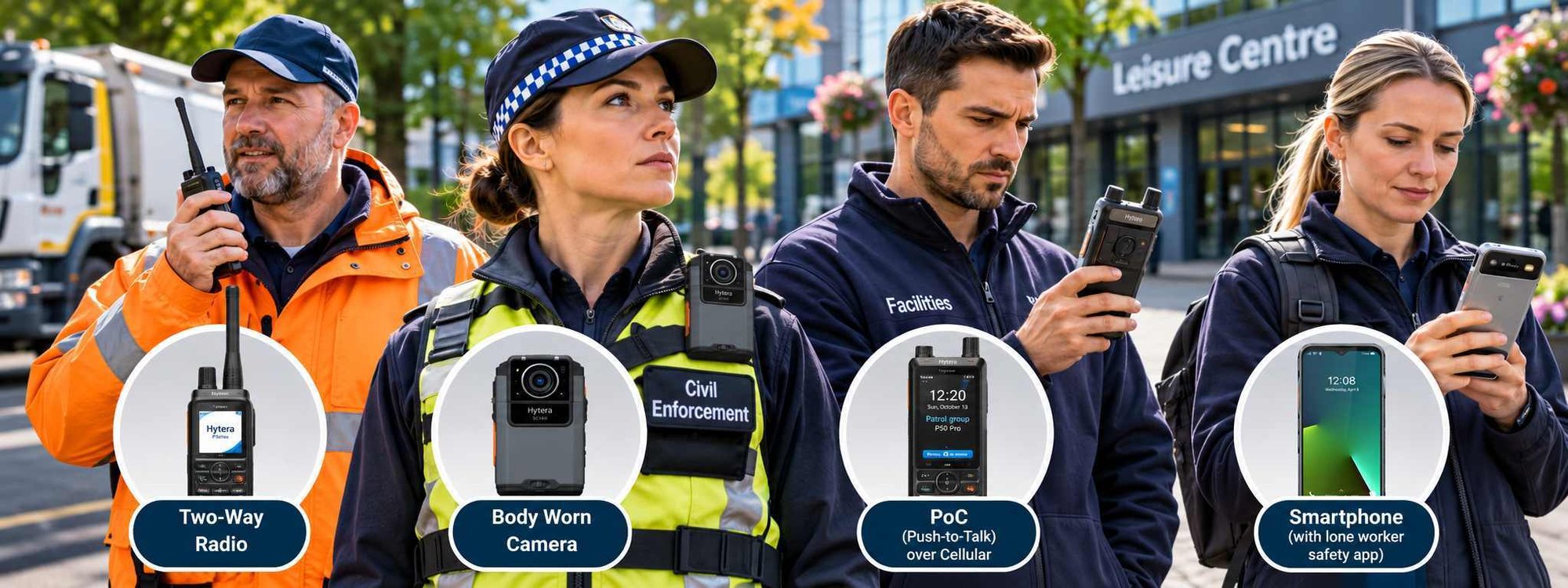
Council employees work in a variety of environments, from busy town centres and residential neighbourhoods to highways, depots and isolated outdoor locations. Having reliable communications helps your teams coordinate their activities, respond to incidents and stay connected throughout the working day.
We provide a range of communication solutions, including two-way radios, Push-to-Talk over Cellular (PoC), smartphones and body worn cameras, with optional SOS and man-down features to help protect employees working alone or in higher-risk environments.
By combining everyday communications with staff safety features, councils can reduce the need for employees to carry separate devices while making it easier for teams to communicate and request assistance when they need to.
PoC enables council employees to communicate instantly with individuals or groups using mobile networks or Wi-Fi. It’s particularly useful for geographically dispersed teams such as waste collection crews, highways maintenance workers and mobile security officers.
PoC can be used on dedicated handheld devices or compatible smartphones, with optional SOS and man-down functions. Devices can also be mounted in vehicles and complement or replace existing radio systems where suitable.
Two-way radios provide reliable, instant group communication for council teams working in depots, leisure facilities, public buildings and other operational environments.
We can design, supply and maintain radio systems, including repeaters to extend coverage and devices with integrated lone worker safety features.
Employees who already carry smartphones can use a lone worker safety app to access SOS alarms, man-down detection and timed check-ins without necessarily needing an additional device.
For those who may need to raise an alarm discreetly, a Bluetooth SOS button can provide a convenient way to request assistance without taking their phone out of their pocket or handbag.
Body worn cameras can help protect frontline employees, particularly those working in public-facing or potentially confrontational situations, such as parking enforcement and community safety.
Alongside video recording and secure evidence management, compatible cameras can offer SOS alerts, Push-to-Talk communication and live video capabilities, helping teams communicate and respond to incidents more effectively.
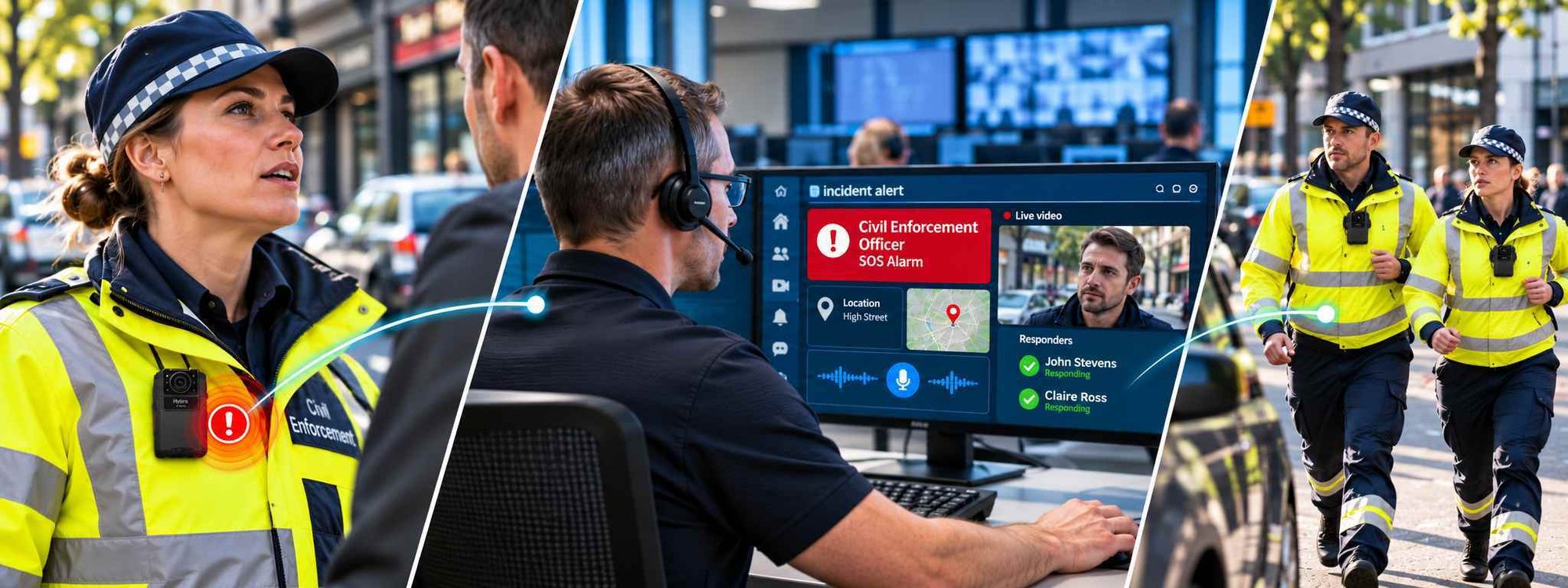
When a council employee raises an SOS alarm or a man-down alert is triggered, it’s important that the right people are notified quickly and can work together to coordinate an appropriate response.
We provide lone worker alarm management solutions with dispatcher software that enables council control rooms to monitor incidents, receive SOS alerts and coordinate responses. Alerts can also be sent simultaneously to designated local responders, allowing everyone involved to share information and collaborate in real time.
Rather than relying on a single person or team to receive an alarm and pass information on, alerts can be sent directly to your central control room and designated local responders.
For example, a Civil Enforcement Officer who feels threatened during a parking enforcement incident could activate an SOS alarm using their body worn camera.
The alarm can be received by the control room through the dispatcher software, providing the operator with the officer's location and, where supported, live video and audio from the incident.
The operator can then use Push-to-Talk communication to coordinate assistance from nearby colleagues, while monitoring the situation as it develops.
Where an incident requires police assistance, your control room, local responders or other staff can contact the emergency services. Some council control rooms also have direct communication links with their local police force, helping them coordinate a response when necessary.
Our dispatcher and alarm management solutions provide a range of features to help you coordinate incidents effectively:
By bringing your control rooms and local responders together, you can make better use of your existing resources and improve how staff safety incidents are managed.
Every council operates differently. Some have 24-hour CCTV control rooms, mobile security teams and established links with local police forces. Others rely on departmental managers, designated responders or external monitoring services.
We work with you to understand your operational arrangements, lone worker risks and available resources before recommending a solution that supports effective alarm monitoring, communication and incident response.
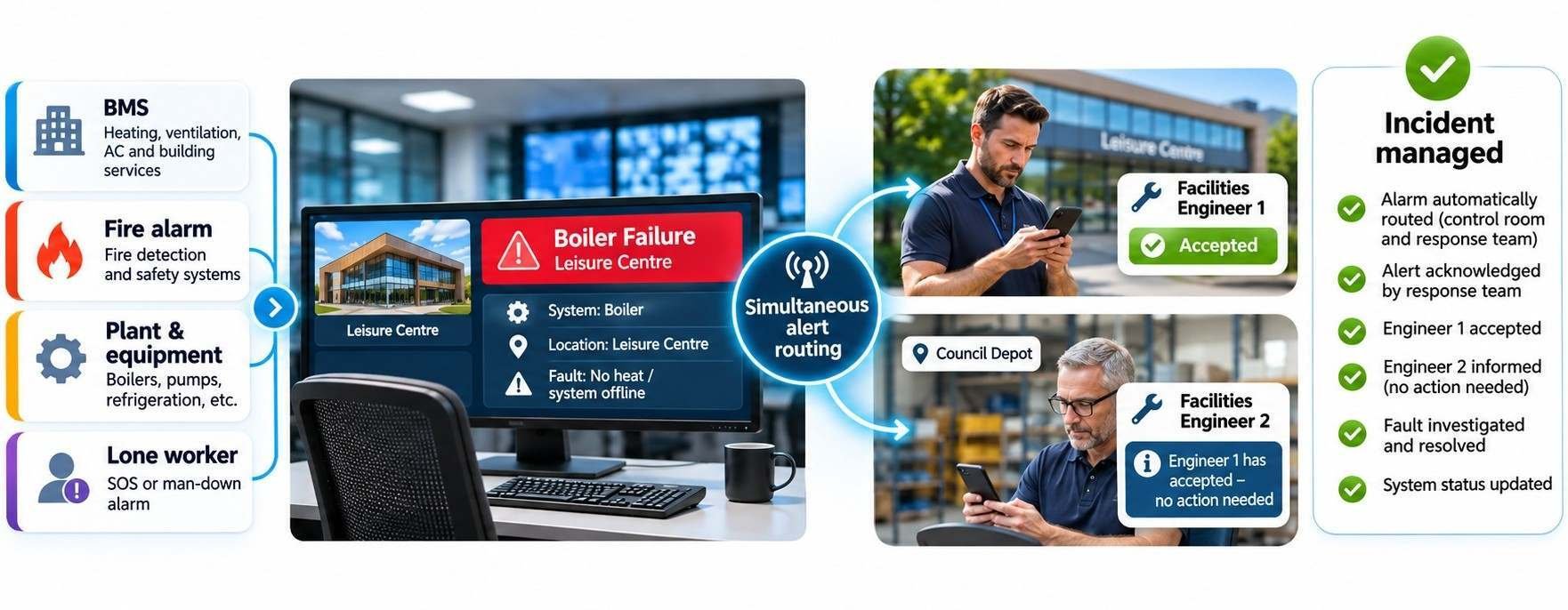
Councils operate a wide range of buildings and facilities, including leisure centres, offices, depots and community buildings. Many rely on essential equipment and building systems that need to operate reliably to keep services running.
When faults or critical events occur, it’s important that the appropriate teams are notified quickly so they can investigate and take action.
We provide critical alarm management solutions that integrate with existing building and operational systems, helping your teams improve how alarms are communicated, acknowledged and escalated.
Our alarm management solutions can receive alerts from a variety of systems, including:
Rather than relying on someone noticing an alarm on a local panel or monitoring screen, alerts can be sent automatically to your control room and designated responders simultaneously, without requiring an operator to forward them.
Depending on the system and operational requirements, alerts can be directed to maintenance engineers, facilities managers, security personnel or central control rooms.
Our solutions support alarm acknowledgement and escalation, helping you to establish clear responsibilities and reduce the risk of important alarms being overlooked.
For example, a critical plant alarm at a leisure centre could automatically notify the facilities team, allowing an engineer to acknowledge the alert and investigate the problem without waiting for someone on site to report the fault.
By connecting critical building alarms with the people responsible for responding, councils can improve operational awareness, reduce unnecessary delays and help maintain essential services.
Councils are responsible for maintaining a wide range of public buildings, from leisure centres and offices to depots and community facilities. Monitoring environmental conditions across these locations can be time-consuming, particularly when staff rely on manual inspections and periodic checks.
We provide wireless environmental monitoring solutions that help you to monitor conditions remotely, identify potential problems early and reduce the need for routine manual checks.
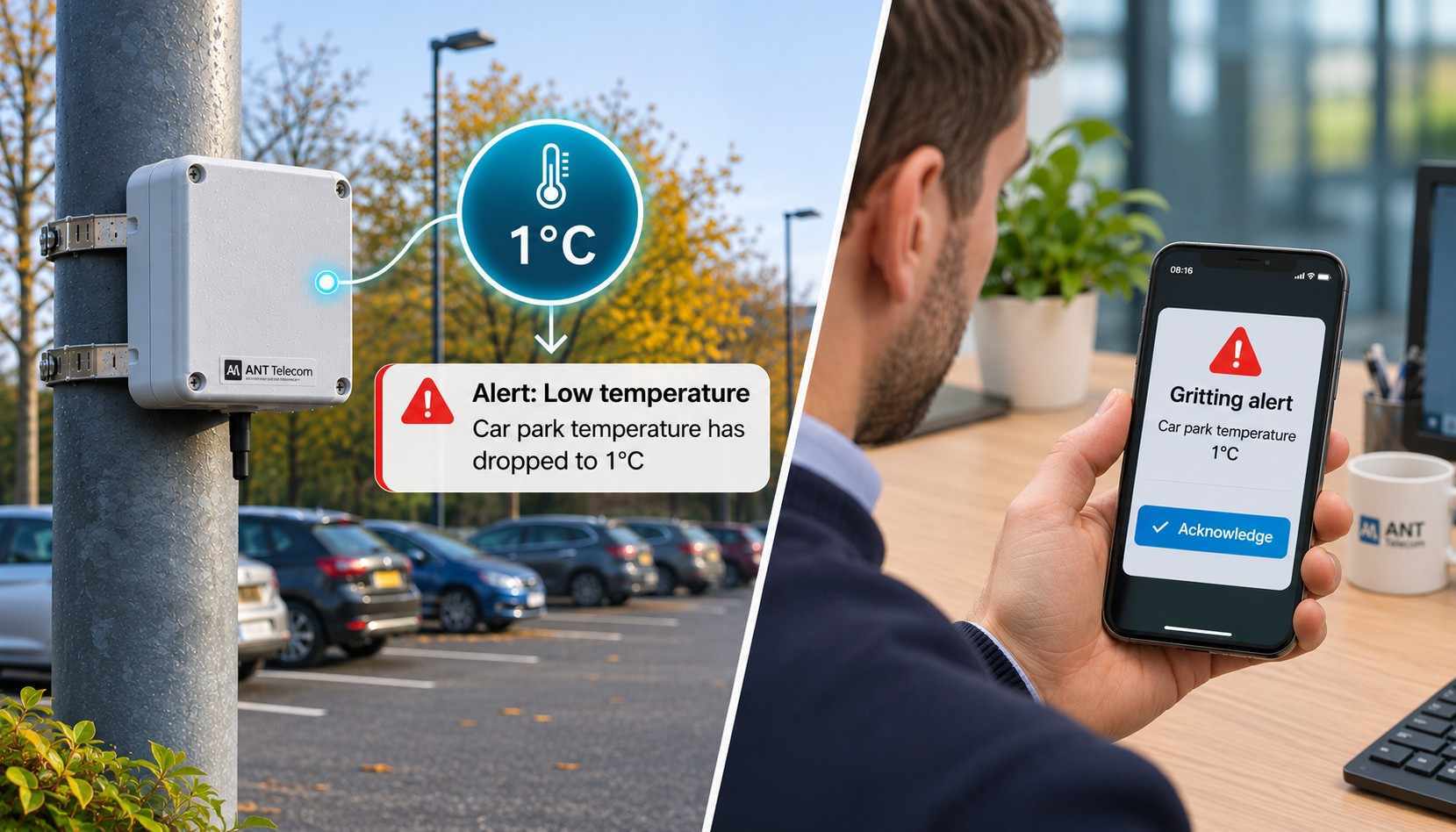
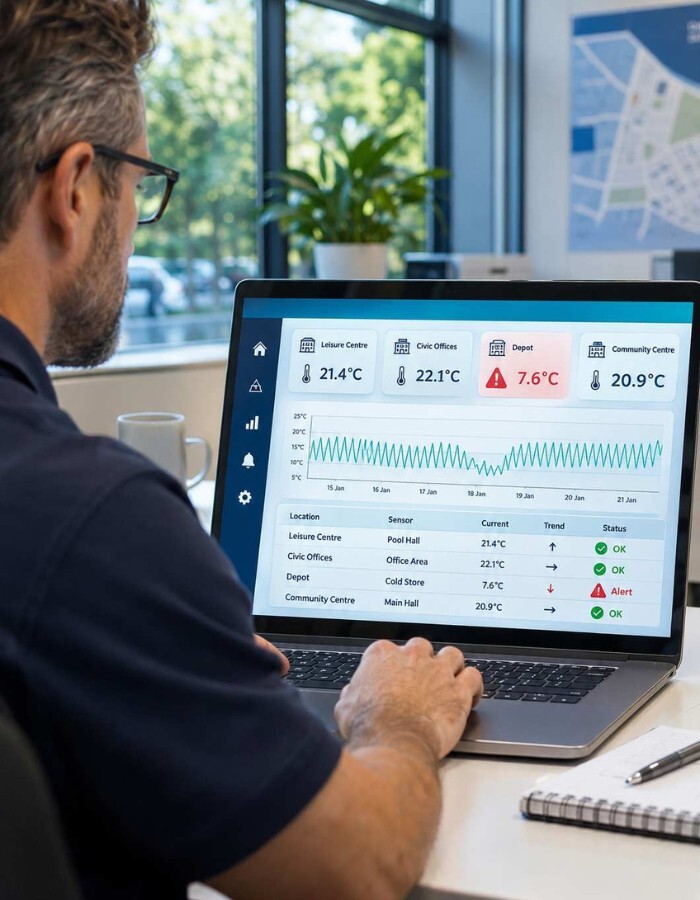
Our wireless sensors can monitor a range of environmental conditions, including:
Wireless sensors collect readings automatically and transmit the information through a gateway to a cloud-based monitoring platform.
Facilities teams can view readings remotely, review historical data and receive alerts when conditions fall outside predefined thresholds.
Using a separate 4G gateway, monitoring can operate independently of the council’s internal IT network, helping simplify deployment across multiple buildings.
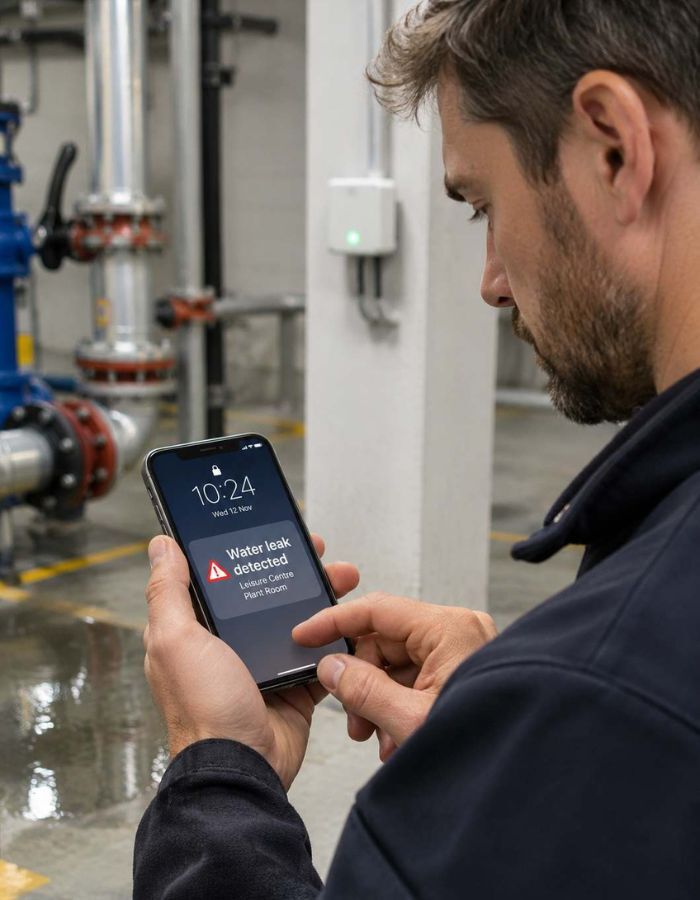
For example, a water leak detected overnight in a council facility could automatically trigger an alert to designated maintenance staff, allowing them to investigate before significant damage occurs.
By automating environmental monitoring, you can improve visibility across your facilities, reduce the time spent on manual checks and respond more quickly when conditions require attention.
Local councils deliver a diverse range of services, each with different communication, staff safety and monitoring requirements.
We can help you identify practical solutions for individual departments, while also exploring opportunities to share technology and resources across the wider organisation.
Housing officers, tenancy support workers and other community-based employees regularly visit residents, sometimes working alone or dealing with challenging situations. We also support housing associations with the same approach.
Lone worker safety apps and compatible communication devices enable employees to raise an SOS alarm or use timed check-ins. Alerts can be shared with council control rooms and local responders, helping teams coordinate assistance when required.
Waste collection and highways teams often operate across large geographical areas, making reliable communication between vehicles, supervisors and depots important.
Vehicle-mounted Push-to-Talk over Cellular (PoC) radios can provide instant group communication, so teams can coordinate activities quickly and stay connected while working across different locations.
Grounds maintenance employees, including those working in parks and other public spaces, may work alone or in isolated areas. Smartphones equipped with lone worker safety apps, or dedicated devices with SOS and man-down features, can help them request assistance when needed.
Parking enforcement officers and community safety teams can face confrontational situations while working in public-facing roles.
Body worn cameras can help capture incidents and provide video evidence, while compatible devices can also support SOS alarms and live communication with colleagues and control rooms.
Leisure centres and public facilities depend on reliable communications and the effective operation of building systems.
We can help staff communicate across facilities, automatically notify maintenance teams of equipment faults and monitor conditions such as water temperature and leaks.
Managing multiple buildings can make it difficult for facilities teams to identify faults and monitor environmental conditions consistently.
Our critical alarm management and wireless monitoring solutions can help identify equipment faults, water leaks and changes in environmental conditions. Early warnings allow your teams to investigate and take action before problems escalate.
Most councils use a mix. Push-to-Talk over Cellular suits teams spread across a wide area, two-way radio suits depots and single sites, and smartphone apps add lone worker protection without another device. We assess how each team works and recommend the combination that fits.
Yes, councils with appropriately staffed control rooms can use them to receive and manage lone worker alarms, provided suitable monitoring and response procedures are in place.
ANT Telecom’s solutions can notify both control room operators and designated local responders simultaneously, allowing them to share information and coordinate assistance as an incident unfolds.
Not necessarily, employees who already carry compatible smartphones can use a lone worker safety app to access SOS alarms, man-down detection and timed check-ins.
Compatible two-way radios, Push-to-Talk over Cellular devices and body worn cameras can also offer staff safety features, helping reduce the need to carry multiple devices.
In many situations, yes, Push-to-Talk over Cellular (PoC) uses mobile networks or Wi-Fi to provide instant individual and group communication, making it particularly suitable for council teams working across large geographical areas.
PoC can replace or complement traditional radio systems, depending on coverage, resilience, operational requirements and existing infrastructure.
Yes, our critical alarm management solutions can integrate with compatible building management systems, fire alarms, security systems and plant equipment.
This allows relevant alerts to be delivered automatically to maintenance teams, facilities managers or control room operators, with acknowledgement and escalation procedures where required.
Yes, our wireless monitoring solutions can measure conditions such as temperature, humidity, CO₂ levels, water temperature and water leaks across different council facilities.
Readings can be accessed through a cloud-based platform, with automatic notifications when predefined thresholds are exceeded.
With over 30 years’ experience in business-critical communications, ANT Telecom helps organisations select and implement solutions suited to their operational needs.
As an independent systems integrator, we work with a range of manufacturers and technologies, providing practical advice and solutions that can integrate with existing infrastructure.
From initial consultation and system design through to installation, training and ongoing maintenance, we provide a complete service backed by experienced technical and account management teams.
Our Accreditations
We hold ISO 9001 (Quality Management), ISO 27001 (Information Security Management) and ISO 14001 (Environmental Management) certifications, demonstrating our commitment to quality, security and environmental responsibility.
Whether you’re looking to improve communication between frontline teams, strengthen lone worker protection, modernise existing radio systems or improve monitoring across council buildings, ANT Telecom can help.
We’ll work with you to understand your existing systems, operational challenges and requirements before recommending a practical, cost-effective solution.
Contact our team to discuss how we can support your council’s communication, safety and monitoring needs. Call 01494 833100.